



Summary: Probate court helps ensure that a deceased person’s assets are properly handled and distributed. Without a valid will, the court will apply relevant state laws to determine how the estate will be handled. It often takes at least nine months for probate to be completed.
Heirs who are waiting for an inheritance payout are required to wait until the estate is settled in probate court before they can collect their share. While this procedure is universal for distributing inheritances, the probate court process is almost always complicated and full of delays.
Luckily, you can skip the court proceedings entirely and get your rightful inheritance immediately! At IFC, we’ll help you learn about what happens when you go to probate court and how to avoid the process altogether so you can get cash when you need it.
What Is Probate Court?
Probate Court Definition: Probate court is a specialized part of the judicial system dealing with wills and estates. Its primary purpose is to ensure a deceased person’s debts are paid and assets are appropriately allocated.
When you go through probate court to receive your inheritance, the court appoints an executor or administrator to represent the estate in question. This individual’s primary responsibility is to oversee the distribution of the estate to the proper beneficiaries, among other legal duties. A probate lawyer will almost always assist in these tasks as well.
The probate process undergoes many delays and can take anywhere from months to years to complete. Unfortunately, heirs usually can’t gain access to their inheritance until probate proceedings conclude.
How Does Probate Court Work?
The probate process begins when someone files a petition for probate in the state’s probate court. A family member or a person designated in the decedent’s will typically files this petition.
The probate court then appoints an executor or personal representative to manage the estate during probate, which involves notifying creditors and beneficiaries, filing court documents and performing other administrative tasks.
Probate Court With a Will
If the decedent left a will, the probate court first determines whether the will is valid. The court must verify that the decedent was mentally capable of creating the will, no fraud or outside influence was involved when it was written, and the will was properly signed.
If the court concludes the will is invalid or someone contests the will’s validity, the court decides how the estate proceeds. If the court determines the will is valid, the estate’s assets are distributed according to the will.
Probate Court Without a Will
In cases where the decedent doesn’t leave a will, the probate court distributes assets to the next of kin, or closest living blood relatives. The part of probate law known as the law of intestate succession outlines how funds should be allocated among spouses, parents, grandchildren, siblings, uncles and aunts.
Can You Avoid Probate Court? Maybe!
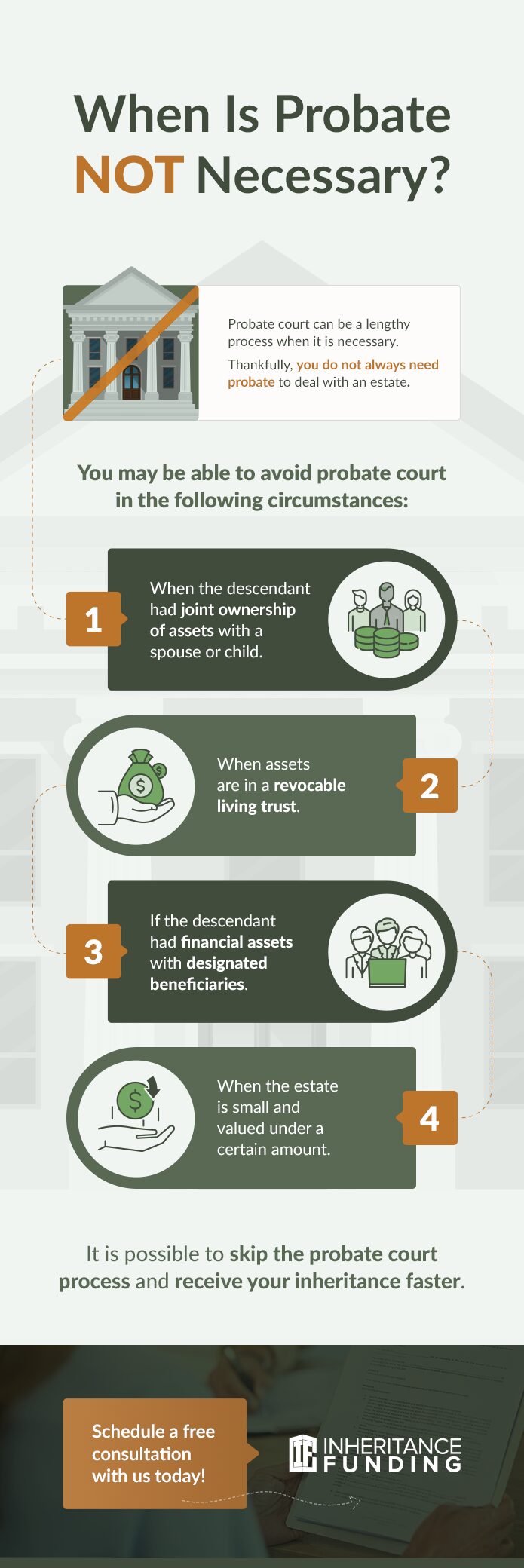
Probate court may not be necessary in a few specific circumstances, such as:
- Joint ownership of assets: If the decedent owned property or assets jointly with a spouse or child, those assets automatically pass to the co-owners, eliminating the need for probate.
- Revocable living trust: If the decedent had assets in a revocable living trust, those assets automatically transfer to beneficiaries per the terms of the trust and are not subject to probate.
- Financial assets with beneficiaries: If the decedent had annuities, retirement accounts or insurance policies with designated beneficiaries, those assets automatically pass to those beneficiaries and do not become part of the probate estate.
- Small estates: If the estate is valued under a certain amount, you may be able to claim assets with just a court-approved affidavit.
Can I Get My Inheritance Money Before Probate Ends?
Yes, you can get your inheritance long before probate ends, and we’re here to make it happen. At IFC, we understand that after the passing of a loved one, the inheritance process can be frustrating and extensive. We believe you should be able to access the money that’s rightfully yours without the struggle of going through probate. That’s why we make securing your inheritance as quick and easy as possible.
We start with a free consultation where you tell us how much money you’d like to receive upfront. Then, we guide you through some simple paperwork before sending you a portion of your inheritance within the same day. Once the court proceedings are over, the estate will pay us directly out of your share and you will receive the remainder of your inheritance. It’s that simple!
Frequently Asked Questions
Here are some commonly asked questions about how probate court works.
Does every estate have to go through probate?
No, not every estate has to go through probate. In cases where all assets had named beneficiaries or were held in trust, full probate may not be necessary. However, if the person who passed away had assets solely in their name and no beneficiary designation, probate may be required.
Additionally, many states offer simpler probate options for smaller estates, though the rules and limits vary by state.
What happens in probate court when there is no will?
If someone dies without a will, the court uses state laws to determine who the heirs of the estate will be and in what order. The order usually depends on state law and family relationships, but spouses, children and other relatives are commonly considered. Probate may take longer without a will, especially if there are questions about who should inherit or manage the estate.
How long does probate court take?
The probate process can take nine months or longer to complete. The exact timeline will depend on several factors, including court schedules, deadlines for creditors to make claims, the number of heirs, the estate’s size and complexity, and disputes.
What assets have to go through probate court?
Assets that go through probate are generally those owned solely by the person who passed away and that don’t have a designated beneficiary, co-owner or trust attached to them. Some common types of assets required to go through probate court include:
- Real estate: This may include houses or land titled entirely in the deceased person’s name without a transfer-on-death deed or joint ownership.
- Individual bank and brokerage accounts: Checking, savings or investment accounts held in a single name are considered assets that must go through probate court.
- Business interests: These include sole proprietorships or shares in privately held companies without pre-arranged succession plans or buy-sell agreements.
What happens to debt during probate?
During the probate process, the executor or person handling the estate is responsible for identifying valid debts, notifying creditors and paying them off using the estate’s assets. Afterward, the remaining assets can be distributed to heirs or beneficiaries.
Get Your Probate Cash Advance at Inheritance Funding Today
You can skip the probate court process and get your inheritance fast with Inheritance Funding. For over 25 years, we’ve helped heirs in all 50 states receive the money they deserve. You can receive your inheritance cash within 24 hours and we offer the lowest prices for the service, guaranteed. As the largest and most trusted name in inheritance funding, you can rely on us for your probate cash advance needs. Contact us to schedule your free consultation today!






 1-800-944-2072